
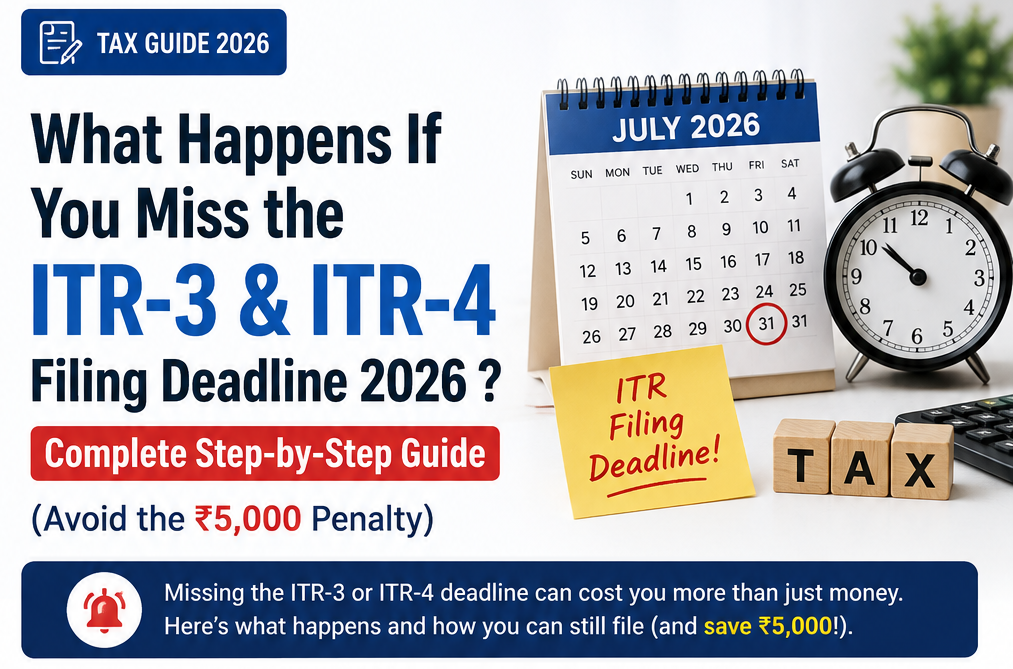
If you run a business, work as a freelancer or professional, or earn income beyond a regular salary, there’s an important date you can’t afford to miss: August 31, 2026. This is the deadline for filing ITR-3 and ITR-4 for non-audit cases in Assessment Year 2026-27, and missing it can cost you real money in penalties and lost benefits.
This guide breaks down everything you need to know — who should file which form, what documents to keep ready, the exact filing process, and how to avoid penalties.
Quick Summary
| Detail | ITR-3 | ITR-4 |
|---|---|---|
| Who files it | Individuals/HUFs with business or professional income who maintain regular books of accounts | Individuals/HUFs with presumptive business income, total income up to ₹50 lakh |
| Due date (non-audit) | August 31, 2026 | August 31, 2026 |
| Due date (audit cases) | October 31, 2026 | Not applicable |
| Late filing penalty | Up to ₹5,000 | Up to ₹5,000 |
| Revised return deadline | March 31, 2027 | March 31, 2027 |
Who Should File ITR-3?
ITR-3 is meant for individuals and Hindu Undivided Families (HUFs) who earn income from a proprietary business or professional practice and are required to maintain formal books of accounts. It’s a fairly comprehensive form and can also capture other income sources alongside your business income, including:
- Salary or pension
- House property income
- Capital gains
- Income from virtual digital assets (crypto/NFTs)
- Foreign income and foreign assets
- Partnership firm remuneration
If your total income exceeds ₹50 lakh and you maintain regular books, ITR-3 is generally the form you need — you can’t use ITR-1, ITR-2, or ITR-4 in this situation.
Who Should File ITR-4?
ITR-4 (also called SUGAM) is the simpler alternative, designed for resident individuals and HUFs who report business income under the presumptive taxation scheme (Sections 44AD, 44ADA, or 44AE) and whose total income doesn’t exceed ₹50 lakh. If you’re a small business owner or professional who doesn’t want the hassle of maintaining detailed books, and you qualify for presumptive taxation, ITR-4 is usually the easier path.
Documents You’ll Need Before You Start
Filing either form gets much smoother if you gather these in advance:
- Form 16 (if you also have salary income)
- Profit & Loss statement and Balance Sheet (for ITR-3, or if you’re opting out of presumptive taxation)
- Bank statements for the financial year
- Form 26AS and Annual Information Statement (AIS) — to cross-check TDS and reported income
- Details of investments and deductions you plan to claim under Chapter VI-A (like 80C, 80D)
- Capital gains statements, if applicable (mutual funds, stocks, property)
- Aadhaar-linked mobile number, for e-verification
Cross-checking your figures against Form 26AS and AIS is one of the most important steps — the portal auto-fills a lot of your data, but you’re responsible for any errors that make it into your final return, even if they came from the pre-filled form.
Step-by-Step Filing Process:
Step 1: Log in to the e-filing portal Go to the Income Tax Department’s official e-filing website and log in with your PAN/Aadhaar credentials.
Step 2: Select the right form and assessment year Navigate to ‘e-File’ → ‘Income Tax Forms’, choose Assessment Year 2026-27, and select either ITR-3 or ITR-4 based on your eligibility.
Step 3: Choose your filing mode You can file online directly through the portal, or download the form, fill it offline, and upload it as an XML/JSON file. Most individuals find the online mode easier since it pre-fills much of your data.
Step 4: Review the pre-filled information carefully Don’t accept the auto-filled data blindly. Check every figure against your Form 26AS, AIS, and your own records — salary, TDS, business income, and deductions all need to match reality.
Step 5: Fill in remaining income and deduction details Enter details for business/professional income, capital gains, house property, and any other income sources. Claim eligible deductions accurately — this is where a lot of refund value gets left on the table if people rush through it.
Step 6: Calculate your tax liability Use the ‘Calculate Tax’ feature to see whether you owe additional tax or are due a refund. If you owe tax, pay it through Challan 280 and enter the challan details in your return before submitting.
Step 7: Preview, submit, and e-verify Review the complete form one more time, then submit. You must e-verify your return within 30 days using Aadhaar OTP, net banking, or a Digital Signature Certificate (DSC) — your filing isn’t considered complete until this step is done.
What Happens If You Miss the Deadline?
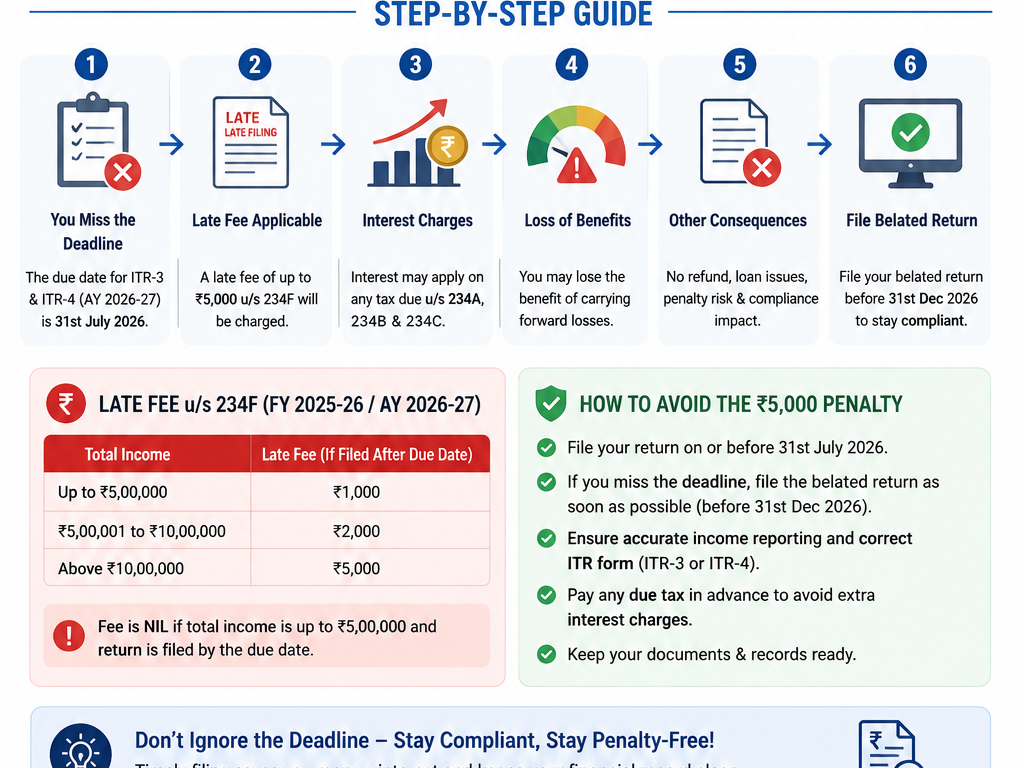
Missing August 31 doesn’t mean you’ve lost the ability to file — but it does get more expensive:
Loss carry-forward restrictions: certain business losses can’t be carried forward to future years if you file after the deadline.
Late filing fee under Section 234F: up to ₹5,000 if you file after the due date but before December 31 of the assessment year. If your total income is below ₹5 lakh, this penalty is capped at ₹1,000.
Interest under Section 234A: 1% per month (or part of a month) charged on any outstanding tax amount until it’s paid.
Delayed refunds: if you’re owed a refund, filing late pushes back when you’ll actually receive it.
Why Filing on Time Matters Beyond Just Avoiding Penalties
A clean, on-time tax filing history isn’t just about compliance — it also plays a role when you apply for loans. Lenders reviewing home loan or business loan applications often look at your filing consistency as a signal of financial discipline, and it can influence the interest rate you’re offered.
Key Takeaways
- August 31, 2026 is your deadline if you’re a non-audit case filing ITR-3 or ITR-4 for AY 2026-27.
- Audit cases get until October 31, 2026.
- Missing the deadline triggers a penalty of up to ₹5,000 (or ₹1,000 for incomes under ₹5 lakh) plus 1% monthly interest on unpaid tax.
- You now have until March 31, 2027 to file a revised return if you spot an error after submission.
- Always cross-check pre-filled data against Form 26AS and AIS before submitting — you’re liable for any errors either way.
Disclaimer: This article is for general informational purposes and shouldn’t be treated as professional tax advice. Tax rules can change, and individual situations vary — consult a qualified chartered accountant or tax professional for guidance specific to your case.